

Riley Roof & Exteriors is based at 1074 Reading Road in Mason, so a roof in Mason is a short drive for us, not a travel job. Most of the roofs we look at here are asphalt shingle roofs on suburban two-story homes, and you get an inspection of the whole roof system, not just the shingles. We’re a GAF Certified Plus™ contractor, and for most homes we recommend GAF Timberline HDZ® shingles, or Timberline UHDZ® when you want GAF’s Class 4 impact-rated option, installed as a complete GAF roofing system.
We’re also an Owens Corning Preferred Contractor. Manufacturer warranties are registered under the manufacturer’s own terms, and workmanship coverage depends on the system: 5 years on a basic install and 10 years on an Owens Corning Preferred roof. On a GAF Silver Pledge roof, GAF’s warranty includes workmanship coverage of 10 years on Timberline HDZ or 15 years on Timberline UHDZ. Your written proposal states the terms.
We’re also proud to be a Brava Certified Installer, offering composite roofing for homeowners who want a slate or shake look, with our 10-year workmanship warranty on BRAVA roofs.
Ready to talk about your roof? Request a Free Roof Estimate and we will come out and walk it.


The roof is a system. The details are the work.
We inspect the deck before covering it and address weak or unsuitable wood. Underlayment, leak barriers, flashings, roof edges and ventilation need to work together. These five details explain our approach.
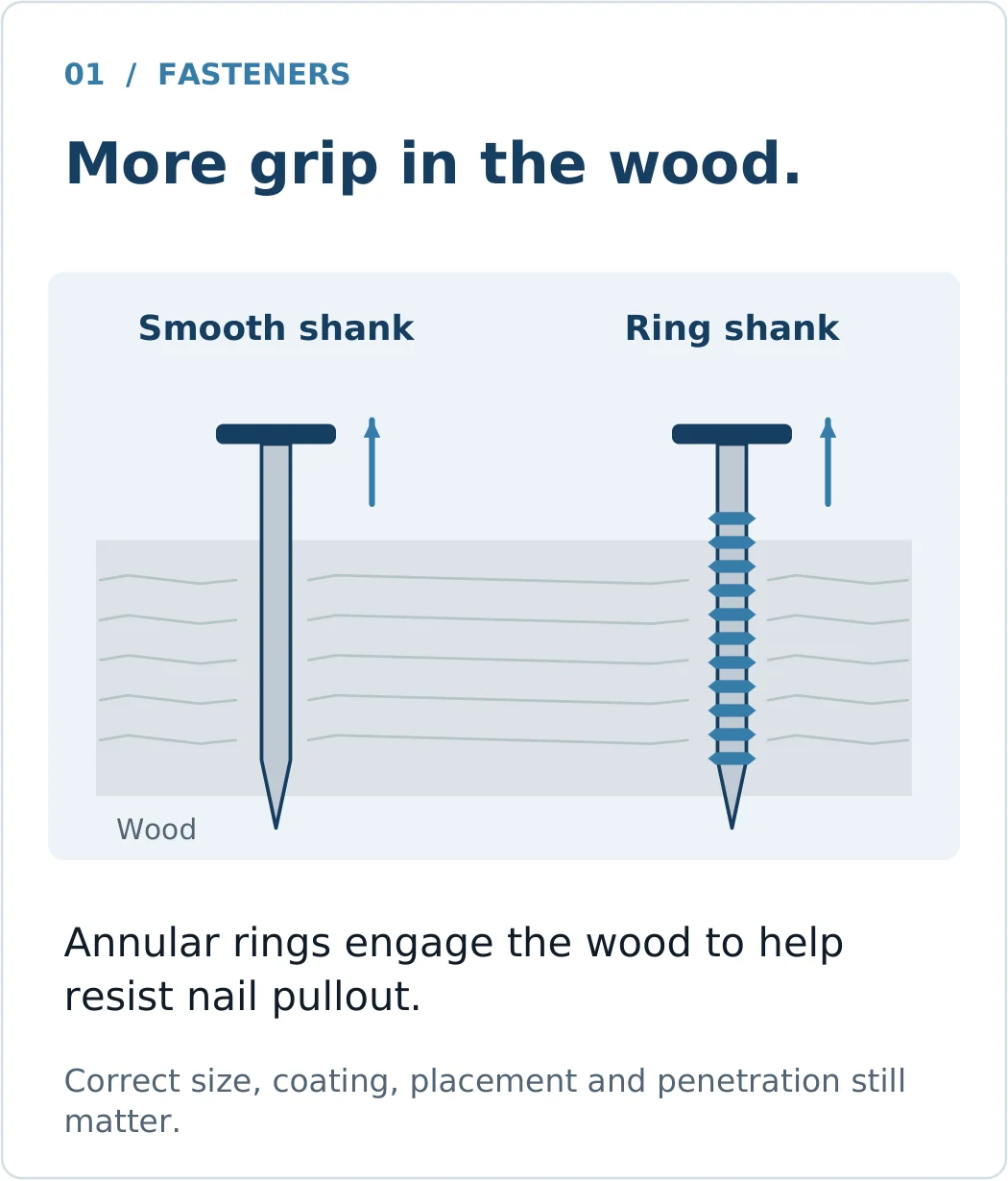
Ring-shank nails
More grip in the wood.
Annular rings on the nail shank engage the wood to help resist pullout. Ring-shank nails are one part of a secure assembly; we also look at the condition of the deck and the fastener length, spacing and penetration the assembly needs.
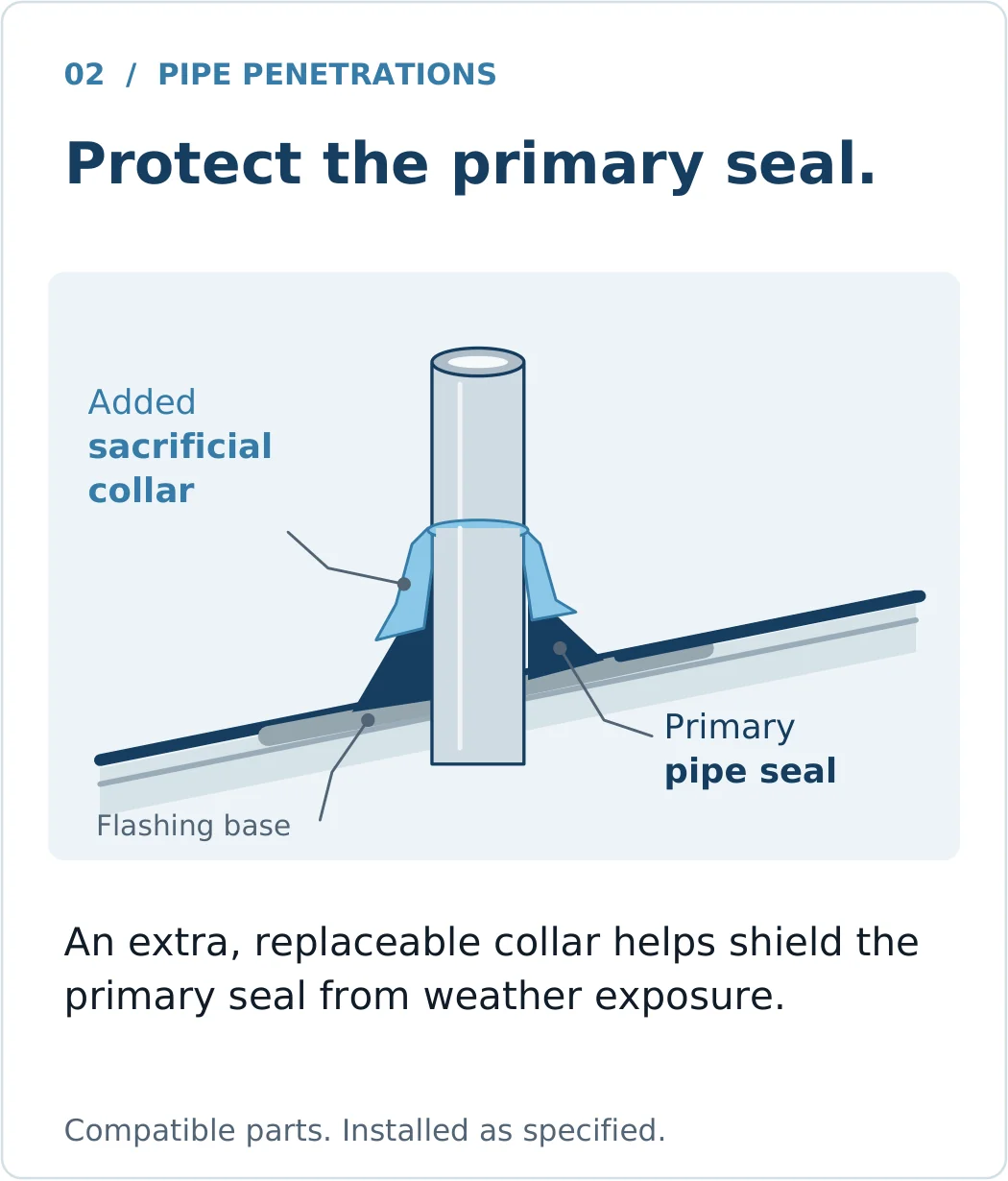
Sacrificial pipe-seal collar
Protect the primary seal.
An extra, replaceable collar helps shield the primary pipe seal from weather exposure. Upgraded pipe boots with a manufacturer lifetime limited warranty are another option, selected for the application.
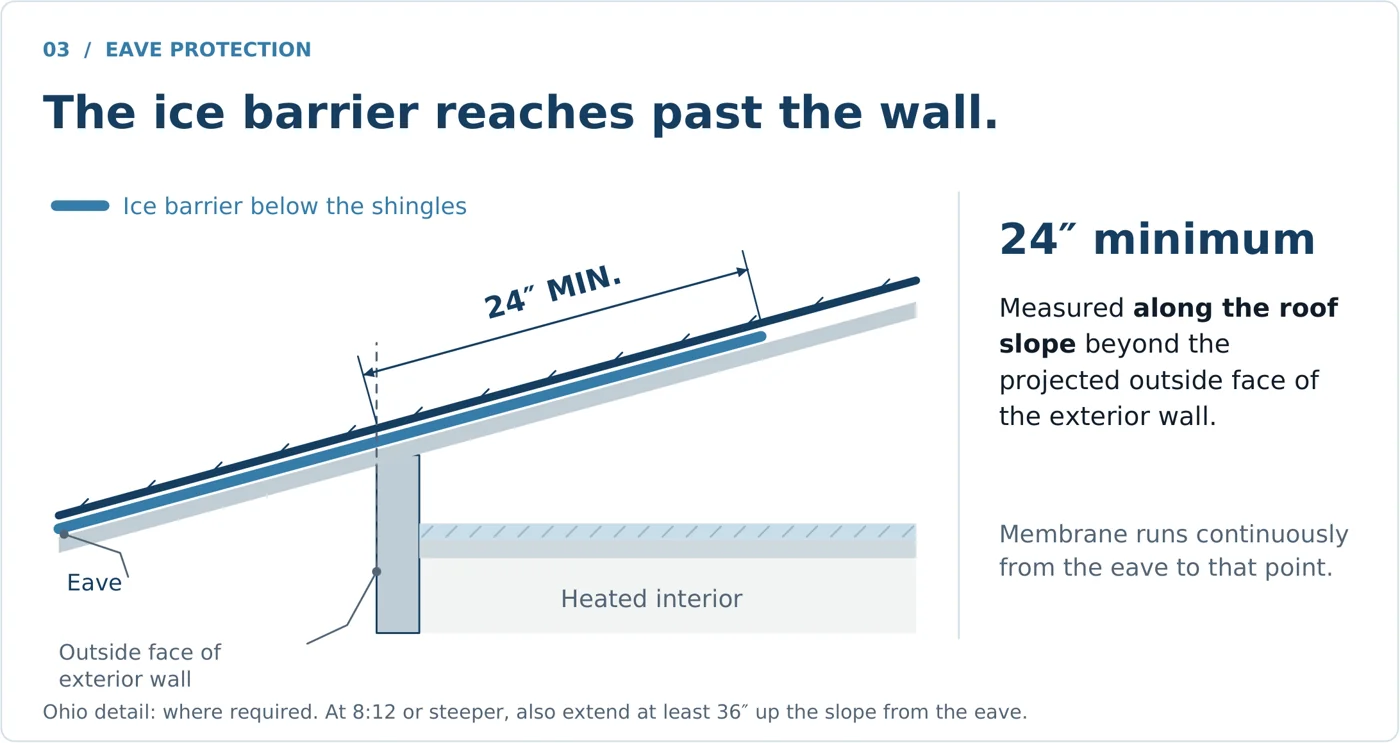
Ice barrier at the eaves
Protection that reaches far enough.
In Ohio, where required, the ice barrier runs continuously from the eave to at least 24 inches past the outside face of the exterior wall, measured along the roof slope. At 8:12 or steeper, it also extends at least 36 inches up the slope from the eave. The overhang changes how much membrane that takes, so we plan coverage around the house itself.
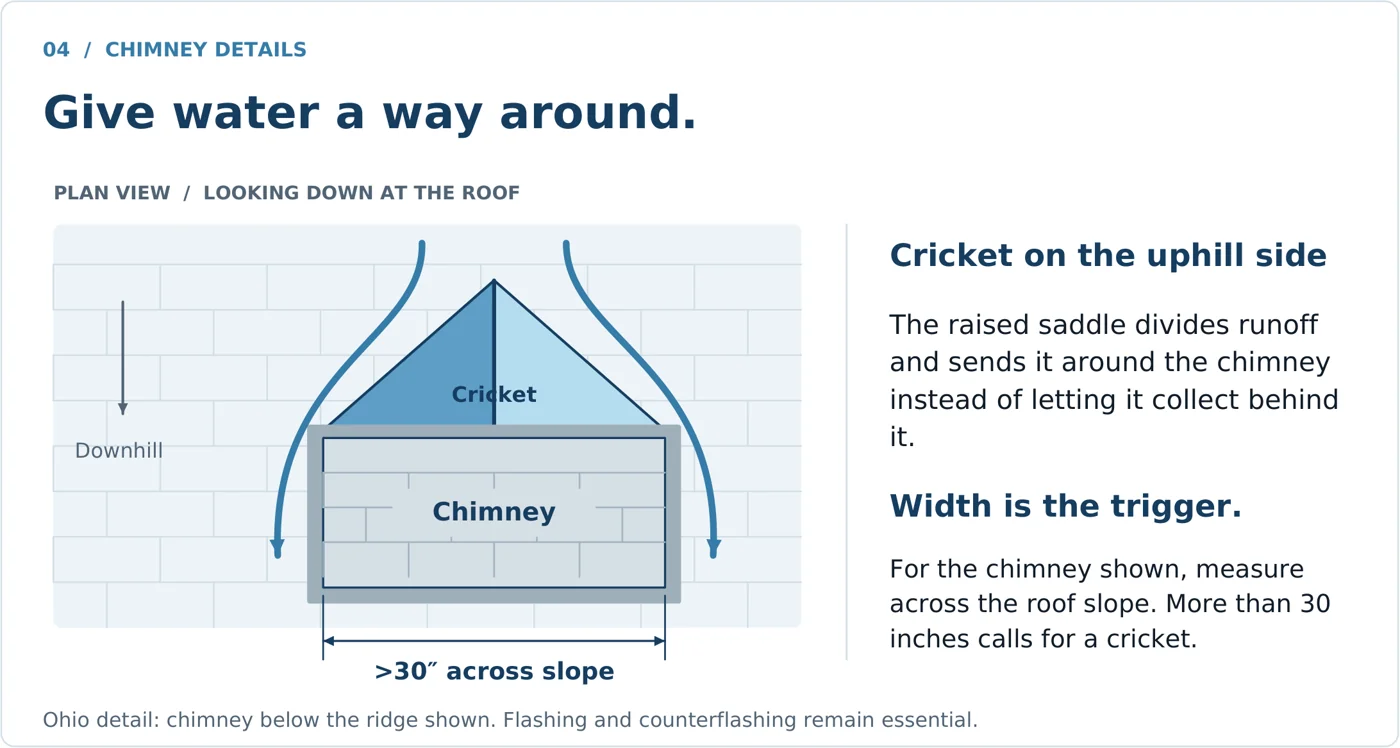
Chimney crickets & flashing
Give water a way around.
A cricket is a raised saddle on the uphill side of a chimney that splits runoff and sends it around instead of letting it collect behind the chimney. For a chimney below the ridge, more than 30 inches measured across the slope calls for a cricket. Flashing and counterflashing at the chimney, walls and valleys still need to be detailed correctly.
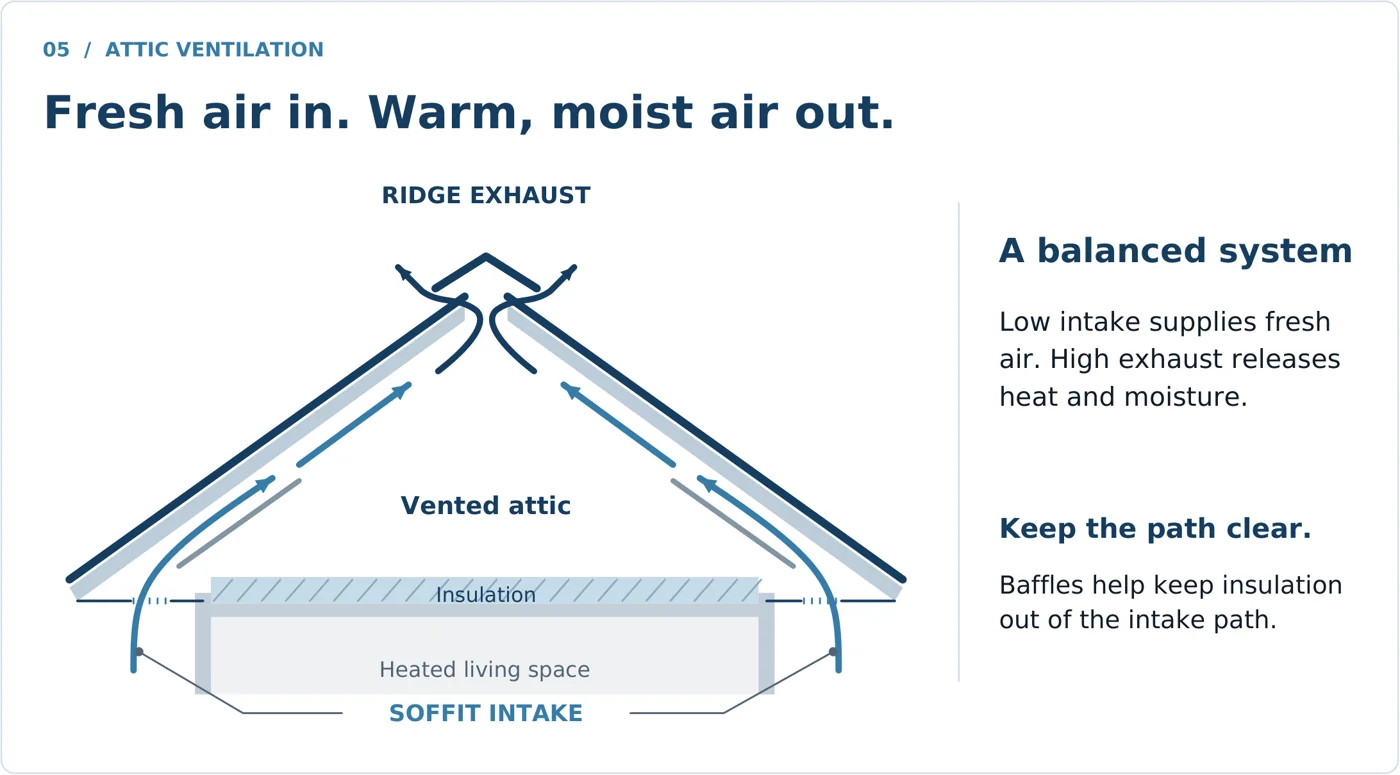
Intake and exhaust, one coordinated plan
Fresh air in. Warm, moist air out.
Low intake at the soffits supplies fresh air, and high exhaust releases heat and moisture. Baffles help keep insulation out of the intake path. We evaluate intake, exhaust and attic layout together and compare net free vent area, the actual open area available for airflow. The answer may be ridge vents, box vents or another approach; the roof determines the recommendation.
The selected fasteners, decking work, pipe-boot assembly, ice barrier, flashing and ventilation belong in your written proposal, so you can see what is included. Illustrations are conceptual and not to scale; product installation instructions and local requirements apply.
Credentials and coverage
- 2026 GAF Certified Plus™ Contractor, GAF ID 1154571. Authorized to offer GAF System Plus and Silver Pledge™ limited warranties on qualifying GAF roofing systems (product, installation and registration requirements apply).
- Owens Corning Preferred Contractor.
- General liability: $2 million each occurrence, $4 million general aggregate.
- Ohio workers’ compensation: Ohio Bureau of Workers’ Compensation policy 80128490.
We provide our insurance and GAF certificates directly to homeowners on request. Ask for updated proof when you schedule your project. Riley is an independent contractor; GAF does not supervise the work.
Frequently Asked Questions
How do I know whether my roof needs repair or replacement?
It depends on how widespread the problems are and how much life the roof has left. A missing shingle, a cracked pipe boot, or a leak at one flashing can usually be repaired. Widespread granule loss, curling or brittle shingles, leaks in several areas, soft decking, or a roof near the end of its service life usually point to replacement. We inspect the roof and attic, show you photos, and explain which option makes sense and why.
What is included in a complete roof replacement?
A complete replacement covers the whole roof assembly, not just shingles: tear-off to the deck, a decking inspection, underlayment, ice and water barrier at eaves, valleys and other vulnerable areas as required, drip edge, flashings, ventilation, starter, shingles, ridge cap, and cleanup with magnetic nail sweeps. Your written proposal shows what is included in the price and what is an allowance or unit price, such as replacement decking, so you know how extra work would be handled.
What is the difference between GAF Timberline HDZ and UHDZ?
Both are GAF architectural shingles with LayerLock technology, and both can qualify for GAF’s 15-year WindProven limited wind warranty with the required GAF accessories. UHDZ is the upgrade: its UltraMat core earns a UL 2218 Class 4 impact rating versus Class 3 for HDZ, it has Dual Shadow Lines for a thicker look, and it carries a 30-year algae warranty versus 25 years. Impact ratings are lab tests, and GAF’s warranty doesn’t cover hail damage. For a slate or shake look, consider BRAVA composite roofing.
What does hiring a GAF Certified Plus contractor mean?
Riley Roof & Exteriors is a GAF Certified Plus contractor, which means we can register GAF enhanced warranties, including System Plus and Silver Pledge, that non-certified installers can’t offer. We’re also an Owens Corning Preferred Contractor, so we can discuss either manufacturer’s systems. Certified contractors are independent businesses, not GAF employees. The certification tells you which warranties are available. It doesn’t replace checking references, insurance, and the written scope.
How do System Plus and Silver Pledge warranties differ?
Both require a GAF certified contractor and a GAF roofing system, and both extend GAF’s non-prorated manufacturing-defect coverage to 50 years on qualifying single-family homes, including tear-off and disposal when necessary. System Plus needs three qualifying GAF accessories and doesn’t cover workmanship. Silver Pledge needs four and, as part of GAF’s warranty, adds workmanship (misapplication) coverage: 10 years on Timberline HDZ, 15 on Timberline UHDZ. Outside Silver Pledge, Riley’s own workmanship warranty is 5 years on a basic install and 10 years on an Owens Corning Preferred roof. Your written proposal states the terms. No coverage period promises roof life.
What happens if you find damaged or unsuitable roof decking?
We replace it before the new roof goes on. Rotted, delaminated, or soft decking won’t hold nails properly, and some older homes have plank decking with gaps that needs new sheathing over it. Because the full deck isn’t visible until the old roof is off, your proposal lists a per-sheet price for replacement decking. We photograph what we find and talk with you before going beyond the quantity in the proposal.
Will you evaluate my attic ventilation and replace the flashing?
Yes. We check intake and exhaust ventilation in the attic, because poor ventilation can trap heat and moisture and shorten shingle life, and GAF’s warranties exclude problems caused by inadequate ventilation. Flashing is part of the roof assembly too. Your proposal states which flashings are replaced, such as drip edge, step and wall flashing, and pipe boots, and how chimneys and siding or masonry walls will be handled. For roof-edge drainage, see our gutter questions.
How long will the work take, and how will you protect my property?
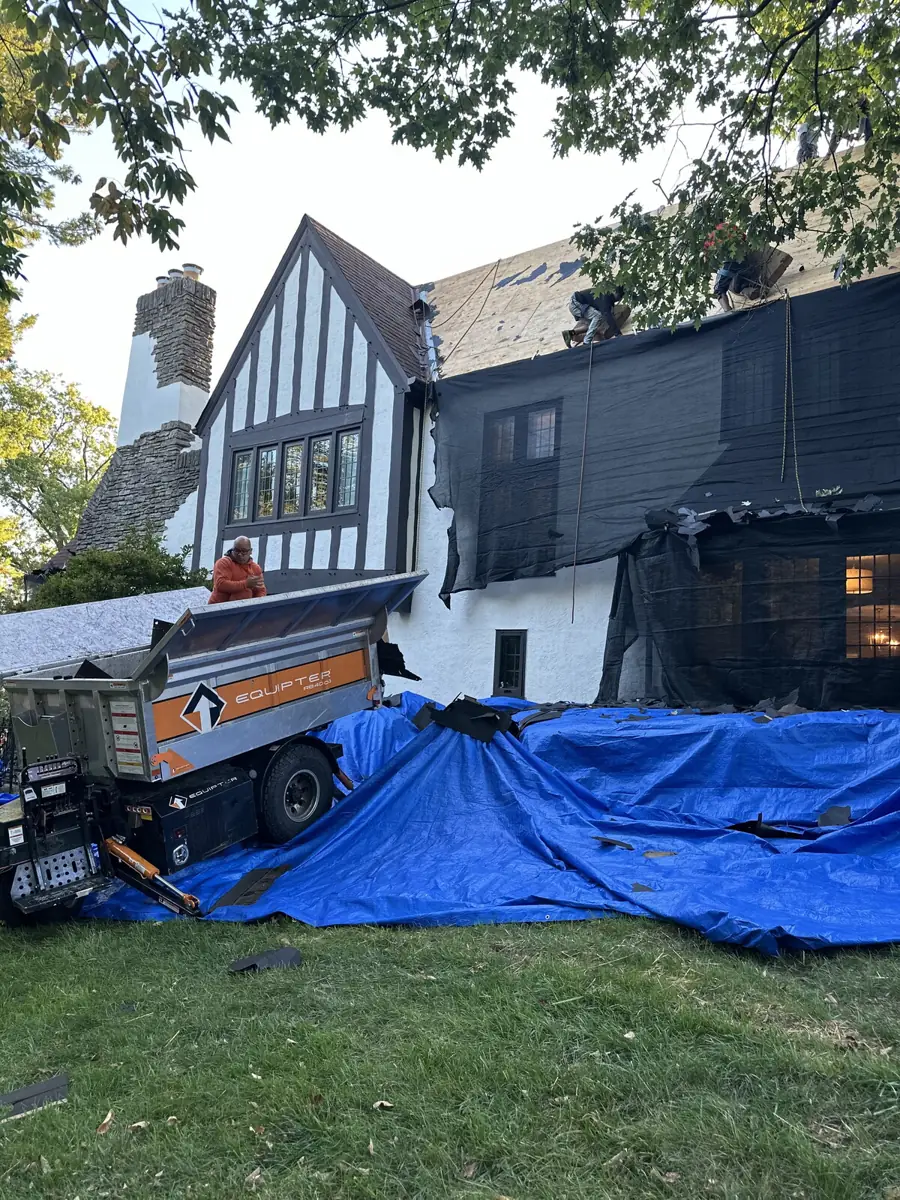
Many single-family replacements take a few days on site, depending on roof size and steepness, the layers being removed, decking repairs, and weather. Before work starts we protect landscaping, windows, and AC units, place the dumpster where it does the least damage, and agree on driveway access. We clean up as we go, run magnetic sweeps for nails, and walk the property with you at the end.
What affects the cost of replacing my roof?
The main factors are roof size and steepness, how many layers come off, decking replacement, the shingle line, the accessories and warranty level you choose, ice barrier and ventilation needs, the chimneys, skylights and walls to flash, and access to the house. We give you a written proposal that shows what’s included so you can compare it line by line. If storm damage is involved, see Insurance Restoration for how claims work.
Why do you use ring-shank nails?
Ring-shank nails have annular rings on the shank that engage the wood and help resist pullout, which helps keep the roof deck attached. They are one part of a secure assembly. The condition of the wood, the nail size, and the fastening pattern also matter, and we identify needed deck work before covering it.
What is a sacrificial pipe-seal collar?
It is an extra, replaceable collar installed over the primary pipe seal. It helps shield the primary seal from weather exposure. Upgraded pipe boots with a manufacturer lifetime limited warranty are another option, and the selected pipe-boot assembly is listed in your written proposal.
How far up the roof should the ice barrier go?
In Ohio, where an ice barrier is required, it runs continuously from the eave to at least 24 inches past the outside face of the exterior wall, measured along the roof slope. On roofs 8:12 or steeper, it also extends at least 36 inches up the slope from the eave. A deeper overhang takes more membrane, so we plan coverage around your house.
Do I need a chimney cricket?
For a chimney below the ridge, a cricket is called for when the chimney is more than 30 inches wide measured across the roof slope. The cricket is a raised saddle on the uphill side that sends water around the chimney. It still needs properly detailed flashing and counterflashing.
Can I see your insurance and GAF certificates?
Yes. We carry general liability coverage of $2 million each occurrence and $4 million general aggregate, and Ohio workers’ compensation through the Ohio BWC (policy 80128490). Our GAF ID is 1154571. We provide the certificates directly to you on request, and we recommend asking for updated proof when you schedule your project.